
ICM Fundamentals: Applying Independent Chip Model in Tournament Play
- 23 Jun 2026

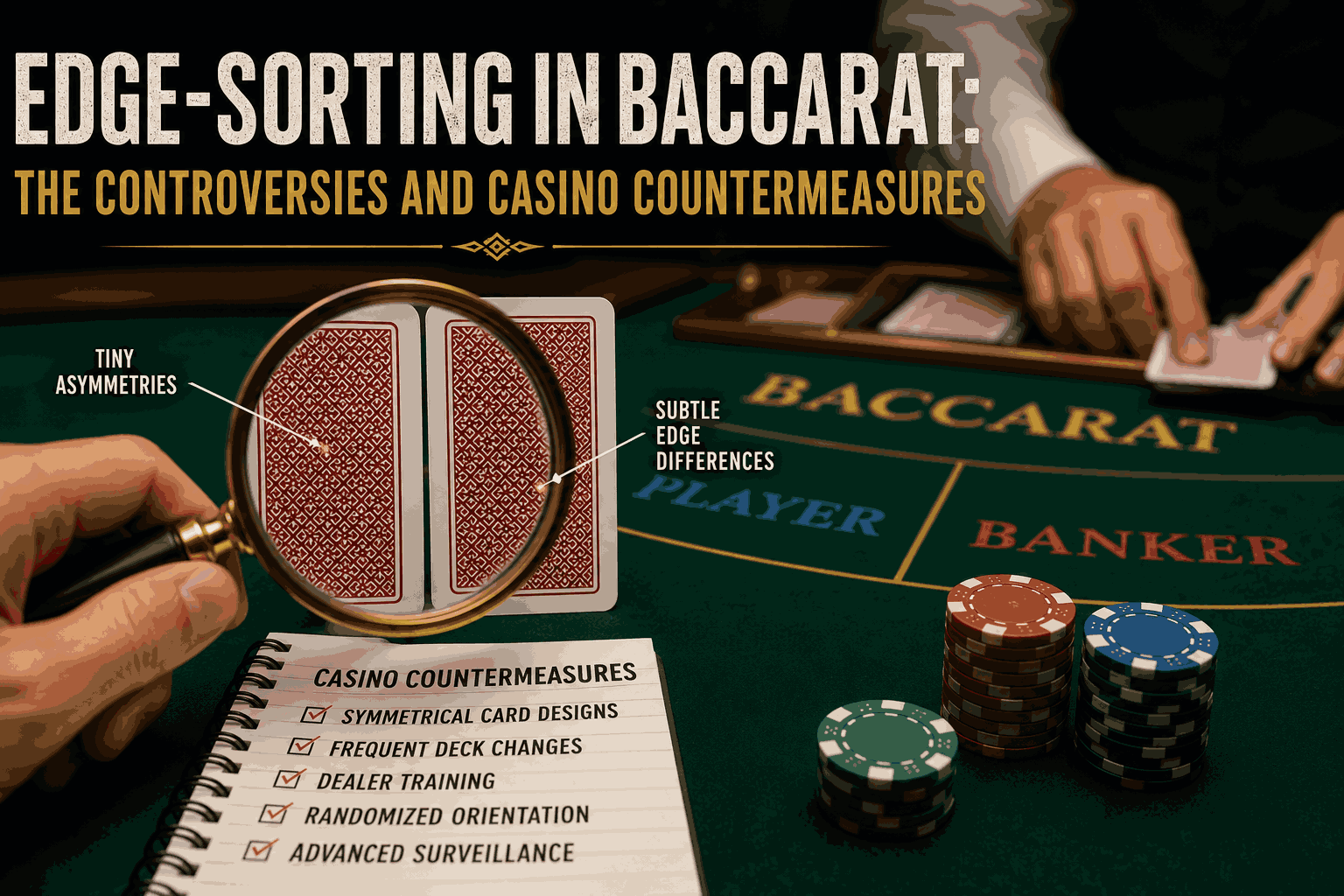
Baccarat has long been associated with luxury casinos, high-stakes gamblers, and sophisticated gameplay. While the game is primarily based on chance, certain players have discovered techniques to gain a statistical advantage without technically cheating. One of the most debated methods is edge-sorting, a strategy that sparked global controversy after professional gamblers won millions from casinos using it.
Edge-sorting sits in a gray area between skillful observation and unfair advantage. Casinos argue that it violates the spirit of fair play, while players claim it merely exploits flaws that casinos failed to notice. The legal battles and public debates surrounding edge-sorting have transformed baccarat into one of the most controversial games in modern gambling history.
Edge-sorting is an advantage-play technique where players identify tiny manufacturing imperfections on the backs of playing cards. These imperfections may appear as asymmetrical patterns, uneven cuts, or subtle differences in card designs.
In baccarat, knowing whether a high-value card or low-value card is coming next can dramatically influence betting decisions. Skilled players convince dealers to rotate certain cards during gameplay under the pretense of superstition or luck preferences. Once the cards are turned in specific directions, players can recognize key cards simply by observing the back patterns.
Unlike card marking, edge-sorting does not involve physically altering the cards. Players only use visual information already present on the cards. This distinction is the foundation of the ongoing legal and ethical debate.
Edge-sorting requires several conditions to be successful:
The process typically unfolds over multiple rounds. Once enough key cards are identified, players can gain a mathematical edge over the casino. In a game with traditionally low house edges like baccarat, even a small informational advantage can lead to substantial winnings.
The most famous edge-sorting controversy involved professional poker player Phil Ivey. In 2012, Ivey and his associate won approximately $9.6 million while playing baccarat at the Borgata in Atlantic City and several million more at Crockfords Casino in London.
Ivey requested specific playing cards, an automatic shuffler, and a Mandarin-speaking dealer. During gameplay, certain high-value cards were rotated. By identifying subtle differences in card backs, Ivey successfully predicted advantageous outcomes.
Both casinos later refused to pay or sued to recover winnings, arguing that edge-sorting constituted cheating. Courts in both the United States and the United Kingdom ultimately ruled in favor of the casinos.
For a detailed overview of the legal case and gambling regulations, readers can refer to the Nevada Gaming Control Board, a leading authority on casino gaming oversight.
The central controversy surrounding edge-sorting revolves around whether it should legally and ethically be considered cheating.
Supporters of edge-sorting argue that:
Many compare edge-sorting to card counting in blackjack, where players use publicly available information to improve odds.
Casinos strongly disagree. They claim that:
Courts often sided with casinos because players intentionally exploited flaws while influencing dealers to assist unknowingly.
Edge-sorting cases have created legal precedents in several countries. Courts generally examine whether players acted dishonestly or interfered with normal gameplay procedures.
In the United Kingdom, courts ruled that edge-sorting breached the principle of “honest play.” Even though the cards were not physically altered, judges concluded that exploiting hidden flaws unfairly compromised the game.
American courts reached similar conclusions. The New Jersey Supreme Court upheld rulings against Phil Ivey, requiring repayment of baccarat winnings to the casino.
These rulings influenced how casinos define cheating and advantage play. Many gaming establishments updated their policies and surveillance systems to detect suspicious behavior related to card orientation requests.
Following high-profile incidents, casinos implemented multiple safeguards to prevent edge-sorting.
Modern casinos now prefer playing cards with fully symmetrical back patterns. This removes visible differences that players could exploit.
Casinos often replace decks more frequently during baccarat sessions. Fresh decks reduce wear patterns and manufacturing inconsistencies.
Dealers are now trained to recognize unusual requests involving card rotation, dealer changes, or special shuffling conditions.
Some casinos deliberately randomize card directions during shuffling to eliminate consistent orientation patterns.
High-definition cameras and AI-assisted monitoring help casinos detect suspicious betting patterns and player behavior.
Many casinos have tightened rules regarding player requests about dealers, card handling, and shuffling equipment.
Edge-sorting has reignited broader discussions about the ethics of gambling advantage strategies.
Professional gamblers argue that casinos already possess a built-in mathematical edge and enormous financial resources. From this perspective, advantage play simply levels the playing field.
Casinos counter that gambling depends on trust and standardized rules. Exploiting hidden defects damages confidence in the integrity of casino operations.
This ethical divide explains why edge-sorting remains such a polarizing topic in the gambling community.
The publicity surrounding edge-sorting significantly changed baccarat operations worldwide. Casinos became more cautious about card manufacturers, dealer procedures, and player requests.
At the same time, the controversy increased public fascination with baccarat strategy and casino psychology. Many casual players became interested in how observation, probability, and human behavior interact within gambling environments.
While edge-sorting opportunities have become far rarer due to stricter casino controls, the technique remains one of the most famous examples of advantage play in gambling history.
Edge-sorting in baccarat represents a fascinating intersection of skill, psychology, law, and ethics. What some consider intelligent observation, others view as sophisticated cheating. The legal battles involving Phil Ivey and major casinos highlighted the complex challenges casinos face in maintaining game integrity while preserving fairness for players.
As casinos continue improving security measures and card technology, successful edge-sorting has become increasingly difficult. However, the controversy continues to shape conversations about advantage play and the limits of strategic gambling.
Ultimately, edge-sorting serves as a reminder that even games built on chance can become battlegrounds for intelligence, observation, and legal interpretation.