
ICM Fundamentals: Applying Independent Chip Model in Tournament Play
- 23 Jun 2026

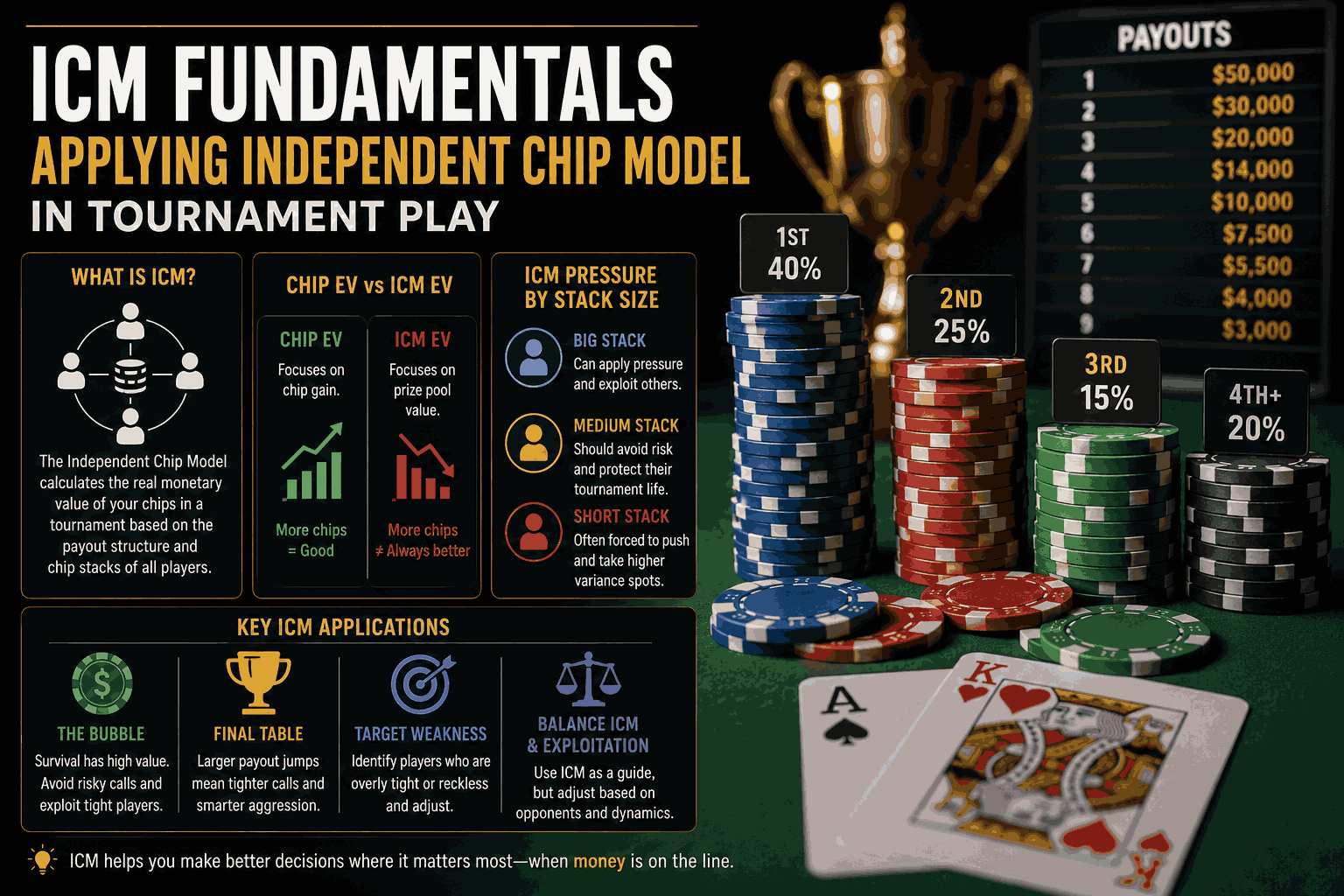
Tournament poker is not just about accumulating chips. As players approach the money bubble, final table, or major payout jumps, every decision becomes more valuable. This is where the Independent Chip Model (ICM) becomes one of the most important concepts in tournament strategy.
ICM helps players understand the real monetary value of their chips during a tournament. Unlike cash games, where chips have a direct dollar value, tournament chips are not equal in value because payouts are distributed unevenly. Understanding this principle can dramatically improve decision-making and increase long-term profitability.
In this guide, we will break down the fundamentals of ICM, explain how it works, and show how players can apply it effectively during tournament play.
The Independent Chip Model is a mathematical system used to estimate a player’s share of the remaining prize pool based on their chip stack relative to the field.
Instead of viewing chips as equal units, ICM converts chip stacks into real-money equity. This means that gaining or losing chips impacts your expected payout differently depending on the tournament stage.
For example, doubling your stack from 10 big blinds to 20 big blinds does not necessarily double your expected tournament winnings. Likewise, losing half your stack can hurt your equity far more than the chips themselves suggest.
ICM is especially important during:
Professional players rely heavily on ICM calculations to make profitable folds, calls, and shoves.
Many players make the mistake of treating tournament poker like a cash game. In cash games, chip EV (expected value) is all that matters because every chip equals money. Tournament poker is different.
Under ICM pressure:
A call that is profitable in chip EV may actually lose money in tournament EV because busting out carries significant financial consequences.
Understanding ICM helps players avoid costly mistakes and exploit opponents who fail to adjust correctly.
One of the most important concepts in tournament strategy is distinguishing between chip EV and ICM EV.
Chip EV focuses purely on chip accumulation. If a play gains chips on average, it is considered profitable.
ICM EV measures how a decision affects your share of the prize pool.
A move can be positive in chip EV but negative in ICM EV because tournament life has value.
For example, imagine calling an all-in with Ace-Queen against a tight opponent near a final table bubble. Even if the call is mathematically profitable in chips, the risk of elimination may make folding the better tournament decision.
This is why tournament professionals often make folds that seem surprising to recreational players.
ICM affects players differently depending on stack size.
Big stacks benefit most from ICM pressure because they can threaten elimination.
Advantages include:
Large stacks should attack players who are trying to ladder into higher payouts.
Medium stacks face the most difficult ICM situations.
They must:
Medium stacks often tighten up because busting before shorter stacks can be financially devastating.
Short stacks usually have less ICM pressure because survival odds are already limited.
As a result, they may need to:
However, extremely short stacks near payout jumps can sometimes survive simply by waiting for another player to bust.
The tournament bubble is one of the clearest examples of ICM in action.
Many players tighten up dramatically because they want to secure a cash finish. Skilled players exploit this fear by increasing aggression.
Key bubble adjustments include:
For example, if several players have shorter stacks than you, calling an all-in with a marginal hand may be a major mistake even if the odds appear favorable.
Understanding player psychology during bubble situations is just as important as understanding the mathematics.
ICM becomes even more significant at the final table because payout jumps are much larger.
A player moving from ninth place to fifth place may increase winnings substantially without even winning many pots.
Final table strategy adjustments include:
For example, if another player can eliminate you while several shorter stacks remain, survival often outweighs taking small edges.
This is why final table poker often looks more cautious than earlier tournament stages.
Many tournament players misunderstand or ignore ICM completely. Here are some of the most common mistakes.
Players often overvalue strong-looking hands like Ace-Jack or pocket eights near payout jumps.
In many situations, these hands become folds because the risk of elimination outweighs the reward.
ICM depends heavily on the stack sizes at the table.
A medium stack with multiple short stacks behind should play differently than a medium stack surrounded by larger stacks.
Some big stacks become overly cautious near final tables.
In reality, large stacks should frequently increase aggression because opponents fear busting out.
Satellite tournaments use extreme ICM principles because all qualifying spots usually pay the same prize.
This means survival matters far more than accumulating chips.
Modern poker players use specialized software to study ICM spots and improve tournament decisions.
Popular study tools include:
These tools help players analyze push/fold ranges, final table scenarios, and bubble situations.
For a deeper understanding of tournament poker mathematics, players can also explore educational resources from the World Series of Poker, which regularly publishes tournament strategy content and professional insights.
Although ICM provides valuable guidance, poker is still a game played against human opponents.
Some players become too fearful under ICM pressure, while others ignore it entirely. The best tournament players adapt accordingly.
Examples include:
The goal is not to follow ICM blindly but to combine it with real-game reads and strategic awareness.
The Independent Chip Model is one of the most essential concepts in tournament poker. Understanding how payouts affect decision-making allows players to navigate bubbles, final tables, and high-pressure spots far more effectively.
ICM teaches players that tournament poker is not simply about winning chips. Sometimes survival is more important than taking small edges, while other situations demand aggressive pressure against cautious opponents.
By learning stack dynamics, adjusting ranges properly, and understanding payout implications, players can make smarter decisions and significantly improve tournament results over the long run.
Whether you are grinding online tournaments or competing in live events, mastering ICM fundamentals is a critical step toward becoming a stronger tournament player.