
ICM Fundamentals: Applying Independent Chip Model in Tournament Play
- 23 Jun 2026

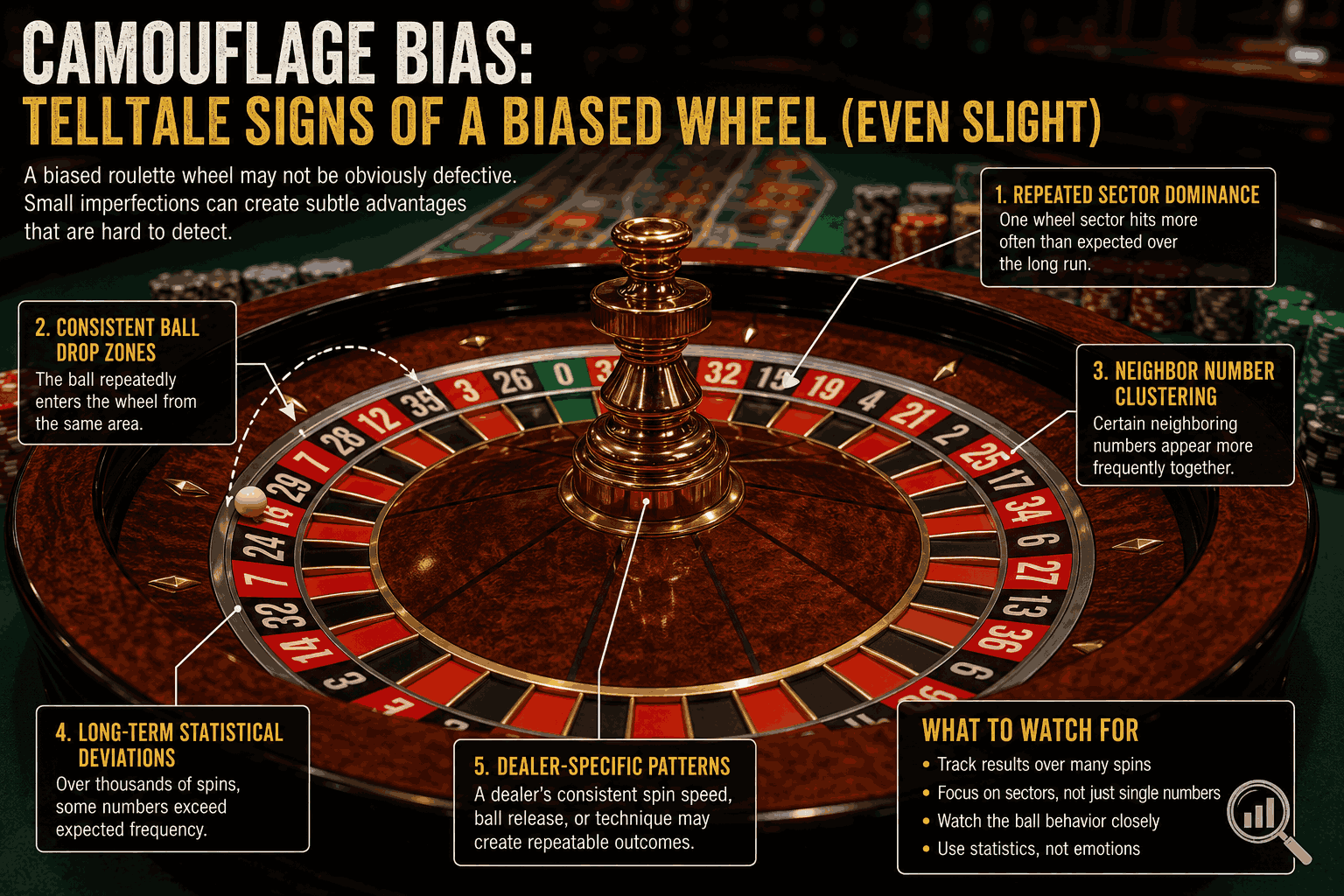
Roulette has long been viewed as one of the purest games of chance in the casino world. Every spin appears random, every bounce unpredictable, and every outcome independent. Yet throughout gambling history, players, mathematicians, and casino experts have debated one fascinating phenomenon — the biased wheel.
A biased roulette wheel is not necessarily broken or visibly defective. In many cases, the bias is so slight that it hides beneath thousands of seemingly random spins. This hidden tendency is often referred to as “camouflage bias” because the wheel disguises its imperfection within normal statistical variance.
Understanding how these subtle biases work can help players appreciate the complexity of roulette and recognize patterns that may not be entirely accidental.
A biased roulette wheel is a wheel that produces certain numbers, sections, or wheel sectors more frequently than probability would normally allow. This imbalance can happen due to:
In a perfectly fair European roulette wheel, each number has a probability of 1 in 37, or approximately 2.70%. However, even tiny mechanical inconsistencies can increase or decrease the frequency of specific pockets over time.
Historically, some professional gamblers made fortunes by identifying biased wheels before casinos improved wheel engineering and maintenance standards.
For a deeper understanding of roulette probabilities and wheel mechanics, the Encyclopaedia Britannica’s guide to roulette offers an excellent overview.
Camouflage bias is particularly difficult to detect because the deviations are extremely small. A wheel may not consistently favor one exact number. Instead, it might slightly favor:
These patterns can remain hidden for long periods because roulette naturally produces streaks and clusters even in fair conditions.
This creates a challenge:
Is the pattern genuine bias or simply random variance?
That uncertainty is exactly what makes camouflage bias so intriguing.
One of the clearest indicators is when a particular wheel sector appears more frequently over extended observation.
For example, numbers surrounding 17, 20, and 22 may repeatedly hit more often than expected over several hundred spins. While short streaks happen naturally, consistent sector dominance over large sample sizes may indicate imbalance.
Professional wheel trackers often focus on wheel sectors instead of individual numbers because subtle bias usually affects nearby pockets together.
Some wheels develop predictable ball drop behavior. The ball may repeatedly lose momentum around the same section of the track before descending onto nearby pockets.
This can happen due to:
Experienced observers sometimes notice that the ball enters the deflectors from similar positions spin after spin.
Although modern casinos frequently rotate wheels and balls to reduce this effect, subtle tendencies can still emerge.
Randomness naturally creates clusters, but camouflage bias often produces recurring neighboring outcomes.
For instance:
Because roulette wheel numbers are arranged non-sequentially, neighboring hits on the wheel layout — rather than the betting table layout — can be more meaningful.
A slightly biased wheel rarely shows dramatic imbalance quickly. Instead, its bias becomes visible only through extensive data collection.
Serious wheel analysts may record:
If a number consistently exceeds expected frequency beyond statistical tolerance, suspicion grows.
However, statistical significance matters greatly. Small samples are unreliable and often misleading.
Sometimes the wheel itself is not the main factor. Certain dealers unintentionally create repeatable spinning habits.
A dealer may:
This can create predictable landing zones under specific conditions.
Known as “dealer signature,” this phenomenon became famous among advantage players decades ago before casinos introduced stricter dealing procedures and automated wheels.
Modern roulette wheels are engineered with incredible precision. Casinos also employ routine maintenance, wheel balancing, and surveillance to minimize irregularities.
Today’s high-end wheels feature:
Casinos have strong financial incentives to ensure fairness because detectable bias can be exploited.
That said, slight imperfections may still emerge naturally over time due to constant use.
Humans are naturally wired to detect patterns, even when none exist. This creates one of the biggest challenges in identifying camouflage bias.
Players often mistake:
for meaningful bias.
This psychological tendency is known as apophenia — the perception of patterns within random data.
Because roulette outcomes are inherently volatile, distinguishing true mechanical bias from randomness requires disciplined observation and large datasets.
Several legendary gamblers successfully exploited wheel biases in the past.
In the 1870s, Joseph Jagger famously analyzed roulette wheel imperfections at Monte Carlo and reportedly won substantial sums by identifying biased wheels.
Gonzalo Garcia-Pelayo became famous for using computer analysis and statistical tracking to identify wheel biases in Spanish casinos during the 1990s.
His methods demonstrated that even modern wheels could sometimes exhibit exploitable imperfections under certain conditions.
Technically, yes — but it is far more difficult than in previous decades.
Modern casinos:
Additionally, many online roulette games use Random Number Generators (RNGs), eliminating physical wheel imperfections entirely.
Still, land-based roulette wheels remain physical machines, and no mechanical system is perfectly immune to wear.
Camouflage bias sits at the fascinating intersection of mathematics, psychology, mechanics, and gambling history. Even slight wheel imperfections can create subtle tendencies that blend into the chaos of roulette randomness.
However, identifying genuine bias requires patience, statistical discipline, and a deep understanding of probability. Most perceived patterns are simply normal variance rather than exploitable flaws.
For casual players, the idea of hidden wheel bias adds mystery and intrigue to roulette. For serious analysts, it remains one of gambling’s most intellectually captivating challenges.
Ultimately, roulette continues to thrive because uncertainty dominates every spin — and even the smallest suspicion of hidden bias keeps the legend alive.